
Here’s a scenario that should make every American pay attention. China is rehearsing an invasion of Taiwan. Not in theory. Not in war games at a think tank. The People’s Liberation Army is conducting large-scale drills simulating encirclement and blockade operations around the island. Chinese aircraft are crossing the median line of the Taiwan Strait routinely. Naval vessels are surging into surrounding waters. Xi Jinping has refused — repeatedly, publicly, on the record — to rule out military force.
And Taiwan’s legislature is arguing about the budget.
The Letter
Thirty-seven U.S. lawmakers — bipartisan, senior, and clearly fed up — sent a letter Thursday to Taiwan’s Legislative Yuan that reads less like diplomatic correspondence and more like an intervention.
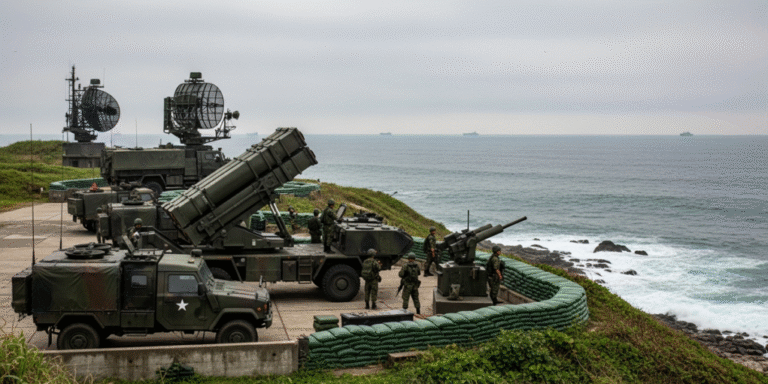
The message is blunt: fund your defense or risk losing everything. Taiwan’s President Lai Ching-te proposed a $40 billion, eight-year special defense package designed to make a Chinese invasion catastrophically expensive. Missiles. Air defense systems. Drones. Reserve force training. The kind of asymmetric warfare capabilities that turn a small island into a porcupine nobody wants to grab.
Taiwan’s opposition parties — which control the legislature — have responded by gutting the proposal. Their counterproposal cuts the budget by nearly 70% and strips out funding for key U.S. weapons systems. Seventy percent. While China practices surrounding them.
That’s not fiscal responsibility. That’s sleepwalking toward disaster.
The Washington Frustration
The American lawmakers didn’t sugarcoat it. “The threat posed by the People’s Republic of China against Taiwan has never been greater,” they wrote. They cited growing military pressure and coercive actions designed to “undermine Taiwan’s will to resist.”
That last phrase is doing the heavy lifting. Undermining the will to resist is exactly what China’s strategy looks like — not a sudden invasion, but a slow squeeze. Constant military pressure. Daily airspace violations. Naval encirclement drills that normalize the idea of Taiwan being surrounded. The goal isn’t to invade tomorrow. It’s to make Taiwan’s population and politicians so exhausted and intimidated that when the real moment comes, the resistance has already been eroded from within.
Taiwan’s opposition lawmakers are playing directly into that strategy. Every dollar cut from the defense budget, every delay in procurement, every political fight that stalls military readiness sends a signal to Beijing: they’re not serious. And Beijing reads signals the way a poker player reads tells.
America’s Problem Too
The U.S. lawmakers were honest about something most politicians in Washington try to avoid. America has its own failures here. There’s a “massive backlog” of approved weapons sales to Taiwan — equipment that’s been authorized, paid for, and is sitting somewhere in the procurement pipeline while Taiwan waits.
“You have our commitment to ensure Taiwan gets the capabilities it needs, faster,” the letter states. “Likewise, we need Taiwan to step up with us.”
That’s the deal. America can’t defend Taiwan if Taiwan won’t defend itself. And Taiwan can’t defend itself if its legislature is too fractured to fund the tools it needs. Both sides of the equation are broken right now, and China is watching both of them with the patience of a predator waiting for the right moment.
Under the Taiwan Relations Act, the U.S. is committed to providing Taiwan with defensive weapons. But there’s a deliberate fog around whether American forces would actually fight. “Strategic ambiguity” is the official policy — designed to keep China guessing without committing the U.S. to a war. That ambiguity only works if Taiwan looks like it’s willing to fight for itself. A legislature that slashes its defense budget by 70% during a military crisis doesn’t look willing. It looks like it’s already given up.
The Stakes
Taiwan isn’t just an island with a complicated political status. It’s the semiconductor capital of the world. TSMC and other Taiwanese chipmakers produce the vast majority of advanced semiconductors that power everything from iPhones to fighter jets to medical equipment. If China takes Taiwan — or even blockades it — the global supply chain doesn’t just stumble. It collapses.
The economic damage would make COVID supply chain disruptions look like a minor inconvenience. Every industry that depends on advanced chips — which is essentially every industry — would face shortages measured in years, not months. The strategic implications are equally severe. China controlling Taiwan’s chip production would give Beijing leverage over every advanced economy on the planet.
That’s what’s at stake while Taipei’s legislators argue about oversight provisions and budget revisions.
The Moment
President Lai is right. “Faced with China’s expanding military threats, nations across the Indo-Pacific region are increasing their defense budgets. Taiwan must follow suit.” Japan is ramping up. South Korea is ramping up. Australia is ramping up. The Philippines is ramping up. The one country that should be most urgently arming itself is the one bogged down in a legislative food fight.
Thirty-seven American lawmakers just told Taiwan to meet the moment. China isn’t going to wait for Taiwan’s opposition parties to finish their committee hearings. The drills are happening now. The aircraft are crossing the line now. The moment is now.
The only question is whether Taiwan’s politicians figure that out before Beijing makes the decision for them.